
Not If, Not When — How Fast?

Published by

on

Here’s a good way to put the potential workforce disruption from AI into perspective. Consider…

Professional copywriters average 3000-5000 words/day.

Average full-time copywriter salary in the US is $73k, but let’s use the minimum reported at builtin.com of $30k.

This puts the minimum rate of 5000 words of human-generated copy at around $120.

OpenAI’s latest model, accessed via API, costs $30 for each 1 million tokens.

That puts the price on 5000 words of content at… 20 cents.

Is the quality of that copy better than what a good copy writer will produce? No. Is it better than *some* of the professional copy writers out there? Probably. Everyone under that line is obsolete.

Do all businesses *need* the best quality copy? Is that need great enough to justify paying a markup of… 600x the cost? Not 600%, mind you — 600x. All jobs where where ‘the best’ isn’t worth six hundred times as much as ‘good enough’ are going to disappear.

Now bear in mind that every single one of the benchmarks above is still rapidly improving for AI tools, which are also becoming more facile with other creative mediums. On the other side of the playing field, the human workforce is basically standing still.

I still believe that the best product comes from humans and AI working on something *together*. The best solution today is often AI drafting with a human finalizing. But with a 600x differential in cost, the shift in *how* the work gets done is inevitable. The only meaningful question is how fast it happens.

4 responses to “Not If, Not When — How Fast?”

  1. lkrulik Avatar
    lkrulik

    The good news is… this type of copywriting is worth 600x as much as ‘good enough’. Inquiring minds also want to know what prompt you used to generate the blog image.

    Like

    1. Christian Force Avatar

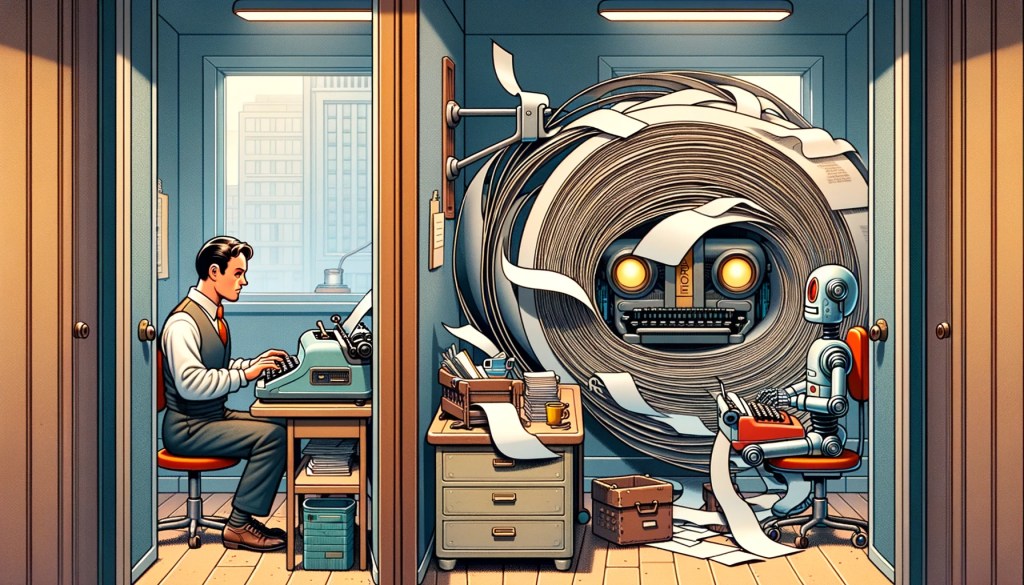
      It was actually more of a conversation than a prompt, using ChatGPT + DALL-E. I started out with “Generate a 16:9 cartoon image of a human and a robot in a 40’s-era office environment. Both are at typewriters. The human has a standard-size sheet of paper sticking up from the top of the typewriter, while the robot has a ribbon of paper that is a thousand times the length, cascading around the room and into the distance. The robot appears calm and cheerful, while the human is glancing nervously over towards the robot, sweat beading on his brow.” Then I gave quite a few rounds of feedback and suggestions on the way to the final version. It was actually a good case study in the ‘collaboration’ pattern — the first image was fairly far off the mark, but it only took 3-4 minutes of back and forth to get to one I was happy with.

      Like

      1. lkrulik Avatar
        lkrulik

        Are you saying you used ChatGPT to generate some of the language that you ultimately gave to DALL-E? Also curious if you’ve ever used Adobe Firefly (https://firefly.adobe.com/) and how it compares. It’s free.

        Like

  2. K Force Avatar

    I have grown to appreciate using chatGPT as a starting point for speeches lately; I’ve always felt that I’m a better editor than writer. I’ve gotten some good writing prompts that I’ve been able to craft into better copy/speech than I could come to on my own. The question is: does using this path make my brain lazier? Probably. I don’t love that part. However, I am also reminded that we were taught in grade school (in the olden days) that using a calculator was a “shortcut” – so perhaps using the tech is a better means to a better end.

    Like

Leave a reply to lkrulik Cancel reply